
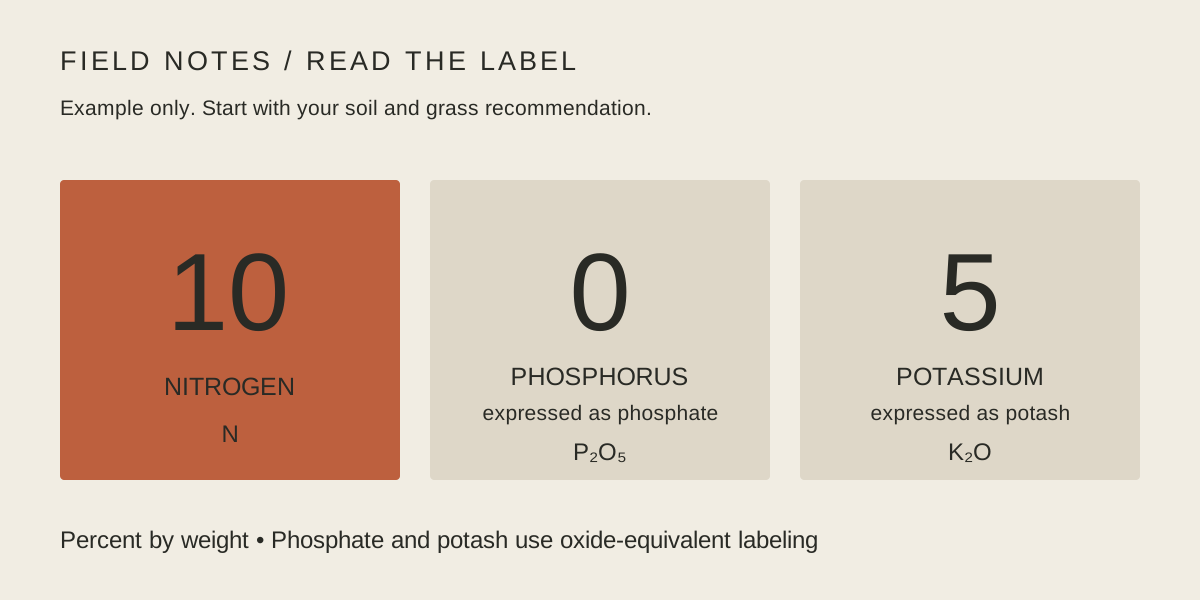
Read the label before choosing a product
The analysis is a percentage by weight, not a list of doses. Keep the bag’s analysis, the lawn’s measured area and the nutrient recommendation together when comparing products.
Turn a recommendation into a decision
Start with a soil recommendation and a grass-specific nutrient plan. Then compare the fertilizer analysis and product label with those needs. A bigger first number means a more concentrated nitrogen source, not automatically a better lawn fertilizer.
Choose your next step
| If you notice… | Check first | Next step |
|---|---|---|
| The report recommends a nutrient amount | Check whether it is expressed per 1,000 square feet or for the whole lawn. | Keep the area basis consistent before converting nutrients into product. |
| Two bags show different grades | Compare the nutrient amounts delivered at the label rate. | Do not compare bag weight or price alone. |
| The spreader setting seems unclear | Use the current product instructions for the exact spreader. | Calibrate output; the N-P-K grade cannot tell you a dial setting. |
A fertilizer-rate calculation, step by step
Worked example, not an application recommendation: suppose a plan calls for 0.5 lb of nitrogen per 1,000 sq ft and the chosen product is 10% nitrogen. Divide 0.5 by 0.10 to get 5 lb of product per 1,000 sq ft. For 2,400 sq ft, multiply 5 by 2.4: 12 lb of product. Check that the result is allowed by the label and local rules.
What a 10-0-5 bag contains
For an example 10-0-5 grade, 20 lb of product contains 2 lb of nitrogen, no listed available phosphate, and 1 lb of soluble potash on the K₂O-equivalent basis. The last number does not mean 5% elemental potassium. This arithmetic describes a bag, not a prescription to apply the whole bag.
Calculate lawn area or sprinkler runtime · Collect a useful soil sample
Avoid an unnecessary treatment
Do not use color alone to choose a fertilizer. Dryness, poor drainage, shade, insects and disease can also affect appearance. If a soil report uses different units or your lawn includes new sod, confirm the interpretation before applying.
Use the patch diagnosis checklist before choosing a treatment.
The same N–P–K grade can have a different release pattern
The three-number grade gives nutrient concentration. Read the nitrogen-source and release information separately: products with the same grade can supply nitrogen at different speeds. Minnesota Extension distinguishes quick-release materials from slow-release materials, including some manufactured fertilizers. Neither a bag’s color nor the word “granular” settles that comparison. Minnesota Extension: Fertilizing lawns, reviewed 2024.
Original comparison: what the numbers establish
Two hypothetical 10-pound bags both marked 10–0–5 have the same label-basis nutrient weights: 1 pound nitrogen, no available phosphate, and 0.5 pound soluble potash equivalent. That arithmetic does not tell you whether their nitrogen-release information is the same, when the grass needs feeding, or which product fits the job.
Save the complete analysis panel and directions from each actual product. Compare them with the grass-specific recommendation and the measured area before calculating the amount to apply. Do not shorten the interval simply because one bag has higher numbers.
Check the nutrient-weight arithmetic · Read the laboratory recommendation and its units. The Minnesota application calendar is regional; no national feeding schedule is prescribed here.
A small, useful toolkit.
Start with what you own. Links labeled search open Amazon results; named models open specific listings. These are researched options, not tested-product rankings. As an Amazon Associate I earn from qualifying purchases. Affiliate disclosure.
Measure the actual turf area
Exclude driveways, beds and patios before calculating a product amount.
Search Amazon: Outdoor measuring tape (paid link)Collect a soil sample
Follow the laboratory’s instructions; a clean trowel may be sufficient.
Search Amazon: Soil sampling probe (paid link)Common questions
What is potash?
On a fertilizer label, potash is the conventional way of expressing potassium content as K₂O equivalent. It is not the same percentage as elemental potassium and does not mean the bag contains pure potassium oxide.
Is 10-10-10 a good fertilizer for every lawn?
No. The grade supplies a particular balance of nutrients. Choose it only when that balance and the labeled application fit the lawn’s actual needs.
Does the middle number mean phosphorus?
It represents available phosphate on a P₂O₅-equivalent basis. Read the report and label on the same basis before comparing amounts.
Sources and regional limits
These references support the care principles and regional examples above. The Minnesota reference explains fertilizer analysis; its crop rates are not lawn recommendations. Use your local Extension office for cultivar, soil and treatment advice. Product labels and local restrictions take priority over a calendar reminder.
- Minnesota Extension: Interpreting soil tests and fertilizer analysis
- Alabama Extension: Home Lawn Maintenance
- USDA: Land-grant university directory
- Minnesota Extension: Fertilizing lawns, reviewed 2024
How this guide was prepared. No on-site inspection or product performance test is implied.
Turn the bag percentages into nutrient weights
A 10 lb bag marked 10–0–5 contains 1 lb nitrogen, 0 lb available phosphate (P₂O₅ equivalent) and 0.5 lb soluble potash (K₂O equivalent). The last number does not mean 0.5 lb elemental potassium.
Use the nutrient-label calculator with pounds or kilograms. It performs percentage arithmetic and does not select a product or treatment rate. Start with the soil recommendation and its units.