Know your grass and site
St. Augustinegrass is a warm-season grass established mainly with sod or plugs. Cultivars differ in shade tolerance, mowing needs and disease susceptibility.
Make the plan fit Florida
UF/IFAS separates Florida into north, central and south regions. Use its cultivar guidance and your lawn’s growth before choosing a feeding window. Check your local fertilizer and watering rules before setting a recurring schedule.
North, central or south Florida?
| Region | Season and planting | What to check |
|---|---|---|
| North | Winter dormancy is common. Avoid establishment in cold winter weather or hot, dry summer conditions. | Sustained growth and the local cold forecast. |
| Central | Avoid cold winter and hot, dry summer establishment. UF/IFAS places the usual first feeding around early April. | Actual growth, rainfall and local fertilizer rules. |
| South | Growth may continue year-round. UF/IFAS favors late fall, winter or spring establishment. | Heat, water availability and local restrictions before ordering sod. |
Regional guidance: UF/IFAS St. Augustinegrass guide. A region is a starting point; your site can differ.
Check the rules for your address
Use the UF/IFAS fertilizer ordinance lookup, then verify the current rule with your city or county. For irrigation, check your water provider and water management district; South Florida’s restrictions page and Southwest Florida’s irrigation guidance are starting points for those districts. Emergency restrictions can change.
Choose the height by cultivar
| Cultivar | Height | Keep in mind |
|---|---|---|
| Floratam / Bitterblue / Classic | 3.5–4 inches | Confirm the cultivar before lowering the cut. |
| Palmetto | 3–4 inches | Its shorter growth habit does not make it a dwarf. |
| Seville | 2–2.5 inches | This range does not apply to every St. Augustine lawn. |
Source: UF/IFAS cultivar descriptions. Unknown cultivar? Ask the sod supplier or local Extension office before choosing a lower cut.
Choose your next step
| If you notice… | Check first | Next step |
|---|---|---|
| A warm week after winter | Mark new growth and note the next few mowing dates. | Wait for sustained growth before adding nitrogen; a single warm afternoon is not a season change. |
| One strip looks dry | Compare catch-cup readings in that strip and a healthy area. | Correct coverage before increasing the runtime of every sprinkler zone. |
| An opening needs repair | Record the cultivar, light and cause of the gap. | Use matching sod or plugs once conditions support rooting; protect the repair from traffic. |
Mowing: check the actual cut
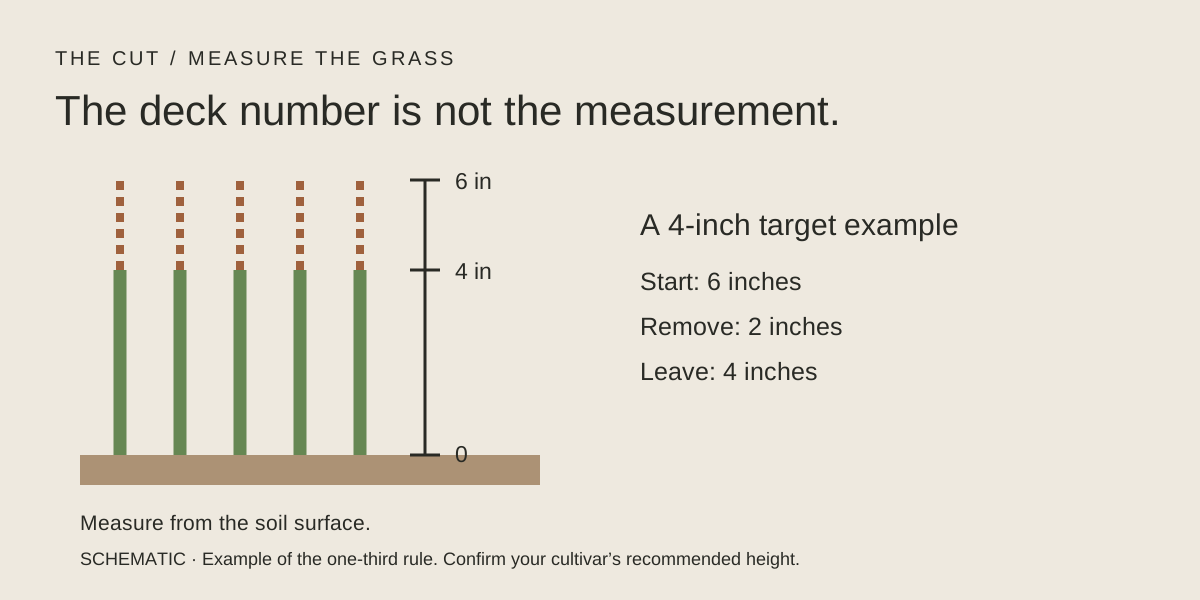
Measure the cut, not just the mower’s numbered setting. Keep the cultivar name with the lawn records. If a normal pass removes too much leaf, increase mowing frequency or raise the cut temporarily instead of forcing one low pass.
Water: measure before adjusting
Separate established turf from recently laid sod. The former needs watering based on conditions; the latter needs establishment care while roots develop. Keep a note of rainfall beside irrigation runtime so a rainy week does not get the same treatment as a dry one.
Calculate lawn area or sprinkler runtime · Collect a useful soil sample
How often should I water St. Augustinegrass?
Established turf needs a condition-based schedule. Folded leaves, a blue-gray cast and lingering footprints can signal water stress. Check the soil and recent rain before watering, and follow local restrictions. Newly planted sod or plugs need separate establishment care.
UF/IFAS explains the watering signs. Use the catch-cup audit to check coverage, then the runtime calculator to translate a chosen water depth into minutes.
How many minutes should the sprinklers run?
Measure delivery before selecting minutes. UF/IFAS explains that runtime depends on sprinkler output, and that rainfall and root-zone conditions can remove the need for a scheduled run. An allowed watering day is not an instruction to water a lawn that does not need it. Watering your Florida lawn.
Original example: converting a chosen depth to time
Four illustrative catch readings after a 12-minute test are 0.19, 0.20, 0.20 and 0.21 inches. The average is 0.20 inches; delivery rate is 0.20 ÷ 12 × 60 = 1 inch per hour.
- If a suitable additional target has independently been chosen as 0.50 inches, the arithmetic gives 30 minutes.
- If that same planning target includes an appropriate 0.20-inch credit for water already received, only 0.30 inches remains; the arithmetic gives 18 minutes.
- If no additional water is needed, runtime is zero.
These are invented measurements to explain the calculation, not a watering schedule or proof that four locations represent an entire zone. Inspect individual readings and runoff; an average can conceal uneven coverage. Do not add the rain credit twice.
Use your own catch depths, test duration and additional depth. New sod needs its separate establishment plan; check moisture beneath the sod and rooting before moving to an established-lawn routine.
Avoid an unnecessary treatment
A yellow patch is a reason to inspect roots, leaf symptoms and water distribution. Buying a fertilizer or fungicide before identifying the problem can spend money without correcting the cause.
Use the patch diagnosis checklist before choosing a treatment.
Compare repair methods · Plan care after laying sod
A small, useful toolkit.
Start with what you own. Links labeled search open Amazon results; named models open specific listings. These are researched options, not tested-product rankings. As an Amazon Associate I earn from qualifying purchases. Affiliate disclosure.
Control one hose-fed watering area
Only if you need scheduled shutoff: the Orbit 62061 series has one outlet, manual watering and rain delay. It does not measure soil moisture or correct uneven sprinkler coverage. Check permitted watering days and whether its interval settings fit your rules; do not assume it suits every new-sod schedule.
View Orbit 62061 on Amazon (paid link) · Compare timer options
Manufacturer specifications and listing identity checked September 29, 2026. Confirm model, seller and package contents before buying.
Check an uneven sprinkler zone
Use identical straight-sided containers you own, or compare catch cups with clear depth markings.
Search Amazon: Irrigation catch cups (paid link)Separate rain from irrigation
A gauge is useful when you are unsure how much rain reached the lawn.
Search Amazon: Rain gauge (paid link)Protect a small sod repair
A temporary barrier can keep repeated foot traffic off rooting sod; check access for mowing.
Search Amazon: Temporary garden barrier (paid link)Common questions
Can I overseed St. Augustinegrass to fill bare spots?
For a matching repair, use sod or plugs of the intended cultivar. Adding a different grass seed introduces a different plant and a different maintenance routine.
Does the whole state stop growing in winter?
No. Record what your own lawn is doing. South Florida can have a longer growing season than north Florida; a statewide month label is only a reminder.
Sources and regional limits
These references support the care principles and regional examples above. Use your local Extension office for cultivar, soil and treatment advice. Product labels and local restrictions take priority over a calendar reminder.
- UF/IFAS: St. Augustinegrass for Florida lawns
- UF/IFAS: Mowing your Florida lawn
- USDA: Land-grant university directory
How this guide was prepared. No on-site inspection or product performance test is implied.
Best time to lay St. Augustine sod in Florida
Choose establishment conditions rather than a statewide month. UF/IFAS favors late fall, winter or spring in south Florida; in central and north Florida, avoid cold winter and hot, dry summer conditions. Arrange irrigation before delivery and check the local forecast.
Source: UF/IFAS St. Augustine establishment guidance. After planting, use the rooting and first-mow checks. For an existing bare patch, compare sod and plugs before ordering.