
A timer tells you how long the system ran. It does not tell you how much water reached each patch. Start an audit with a simple sketch, a notebook and matching straight-sided containers. You may already have everything you need.
Inspect one zone before measuring
Start with the controller’s zone name and current schedule. Walk the zone while it operates and record leaks, damaged heads, spray hitting hard surfaces and obstacles blocking coverage. EPA WaterSense recommends regular inspection and adjustment. Repair obvious defects first; persistent pressure or underground problems may need an irrigation professional.
Run a repeatable catch-cup test
Use identical straight-sided containers placed across representative parts of one zone, including the problem area. Choose calm conditions so wind does not dominate the comparison. Record the test duration, then measure each collected depth with the same units. Keep the container positions on a sketch so a second test can use the same locations.
Check the spread before using the average
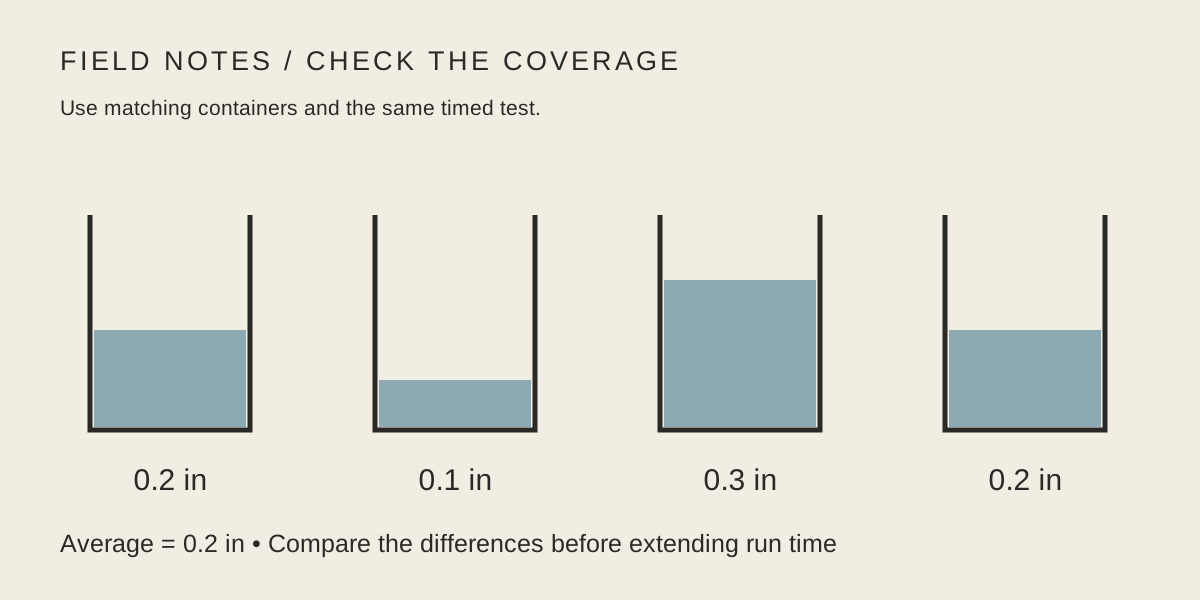
Add the depths and divide by the number of cups. Also inspect the individual readings: an average can conceal a nearly dry corner and an overwatered strip. Correct a large coverage difference before increasing the runtime. Repeat the test after changes; keep both sets of readings instead of overwriting the first result.
Set the target from the lawn’s needs
The calculation below converts depth to minutes; it does not decide how much water your lawn needs. Consider grass, rooting depth, soil, recent rain and local restrictions before choosing a target. If runoff starts, stop and investigate. Where appropriate, shorter cycles with soaking pauses can help water enter the soil rather than leave the property.
A catch-cup example you can check
Illustration: four containers in one zone, tested for 12 minutes. These are example readings, not measurements from your lawn.
Download the printable worksheet One page · PDF · print or fill in a compatible PDF app
| Container | Collected depth | Location in this example |
|---|---|---|
| A | 0.18 inches | Near the beginning of the zone |
| B | 0.20 inches | Middle of the zone |
| C | 0.22 inches | Far edge |
| D | 0.20 inches | Previously dry-looking area |
- Average depth
(0.18 + 0.20 + 0.22 + 0.20) ÷ 4 = 0.20 inches.
- Application rate
0.20 inches ÷ 12 minutes × 60 = 1 inch per hour.
- Example runtime
If a separately chosen target were 0.40 inches, 0.40 ÷ 1 × 60 = 24 minutes total. This is an illustration, not a weekly prescription.
The average alone is not a uniformity score. A zone with readings of 0.02 and 0.38 inches also averages 0.20, but has a serious coverage difference. Do not water the wet area longer just to rescue the dry one.
Your field record
Copy these headings into a notebook or a note on your phone, then keep the before-and-after observations together.
- Date and zone name
- Test minutes and weather
- Location and depth of every cup
- Repairs or setting changes
- Repeat-test readings and any runoff
Common questions
Can I use food cans instead of buying catch cups?
Yes, matching straight-sided containers can work for a simple depth comparison. Keep them upright and measure consistently. Different shapes or narrow openings can make comparisons misleading.
Does a successful audit prove the lawn gets enough water?
It shows how that zone distributes water during the test. The target amount, root-zone response and seasonal schedule still need to fit the lawn.
Separate an observation, an estimate and a watering decision
The catch-cup depths are observations. Runtime is an estimate assuming the system applies water at the same rate. Whether the lawn needs that additional water is a separate decision based on soil moisture, grass, rainfall and current restrictions.
Worked example: four cups collect 0.2, 0.25, 0.2 and 0.15 inches in 15 minutes. Their average is 0.2 inches. A separately chosen additional target of 0.3 inches gives 0.3 ÷ 0.2 × 15 = 22.5 minutes. The test already applied water; do not treat it as free extra irrigation.
If one cup is empty, include that zero. Fix coverage and repeat the measurement before using an average to set a runtime. Try the same values in the calculator or compare adjustment limits before buying a sprinkler.
Four cups are an example, not a complete irrigation audit
The small example above teaches the arithmetic. Minnesota Extension’s home-lawn audit uses at least 20 catch containers distributed across each irrigation zone. Its lower-quarter uniformity calculation divides the average of the lowest quarter of readings by the average of all readings. Minnesota Extension: Auditing home lawn irrigation systems.
Keep zero readings: leaving them out hides dry areas. A short trial with four containers can reveal an obvious problem, but it does not sample a complete zone well enough to certify its performance. Use matching straight-sided containers and one depth unit throughout.
Credit the water applied during the test
In the original example, a separately chosen 0.40-inch total event target would take 24 minutes at the measured rate. The 12-minute test already delivered an average 0.20 inches. That leaves 0.20 inches, or 12 more minutes at that rate, if the lawn and conditions still justify the additional water. The runtime calculator asks for the remaining depth, not the total event target. These figures illustrate arithmetic, not a weekly prescription.
Use the result before buying a controller
If one part of the zone collects almost nothing, a longer run also gives more water to the already wet areas. Inspect obstructions, heads and pressure first; repeat the test after a repair. The runtime calculator shows the spread and, for a suitable sample, the lower-quarter comparison. It does not decide the lawn’s required water depth or certify the system.

A rain gauge in one place cannot tell you whether every sprinkler zone is uniform.